What is High Agency?
High agency is the disposition to act on the world rather than be acted on by it. The term, popularised by Eric Weinstein in a 2016 podcast appearance[1] and amplified through writers including Shreyas Doshi, Naval Ravikant, George Mack, and Cate Hall, names a specific kind of person: the type who treats constraints as negotiable, finds paths through closed doors, and assumes permission rather than waits for it.
That is the short answer. The rest of this article is about where the phrase comes from, what the disposition looks like in practice, what it is commonly mistaken for, why it has become unusually salient in the 2020s, and where serious thinkers about it disagree.
Where the term comes from
The clearest early statement of the modern sense is Eric Weinstein on Tim Ferriss’s podcast in January 2016. Asked to explain what “high agency” meant, Weinstein answered: “When you’re told that something is impossible, is that the end of the conversation, or does that start a second dialogue in your mind, how to get around whoever it is that’s just told you that you can’t do something?” He went on: “You’re constantly looking for what is possible in a kind of MacGyverish sort of a way.”[1] That is the core: a high-agency person hears “you can’t” and starts a second conversation about how to get around it.
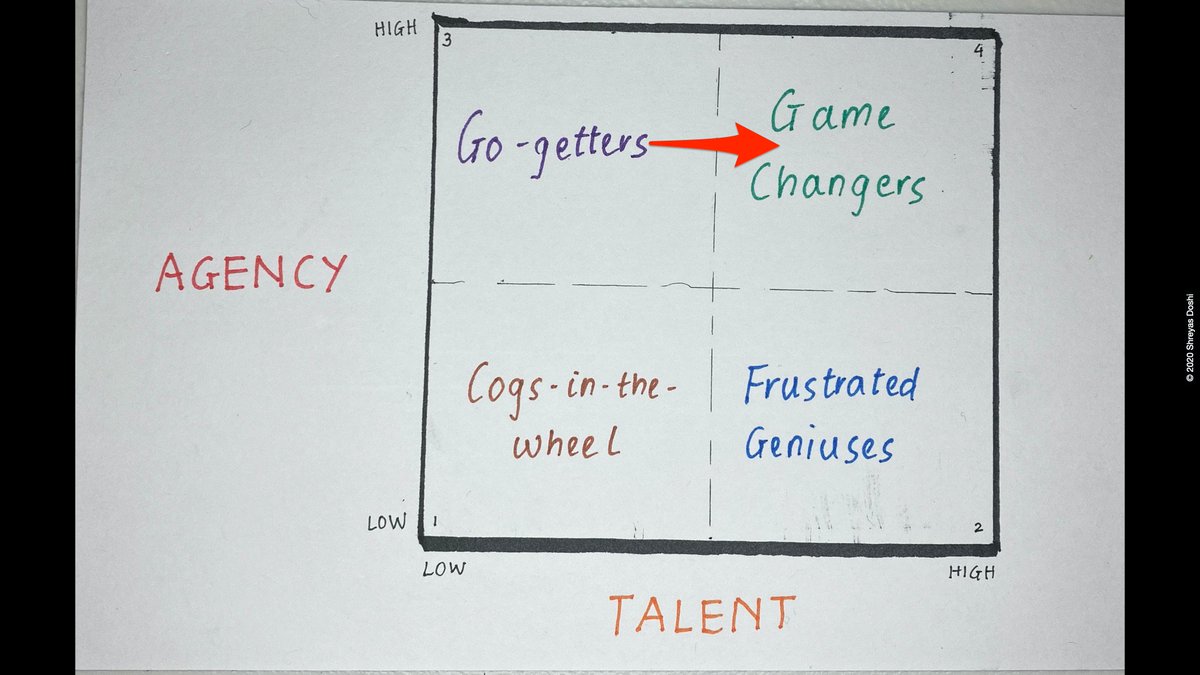
The phrase took hold over the following years. In 2020 the product manager Shreyas Doshi posted a popular X thread that distinguished agency from talent: high-talent, low-agency people, he wrote, end up as “Frustrated Geniuses.”[2] Naval Ravikant, in a widely-circulated 2024 clip about hiring, defined high-agency people as those “who just solve problems without even being asked to solve the problem—they identify the problem, they go solve it.”[3] George Mack’s site High Agency in 30 Minutes described them more vividly: “they are happening to life. They don’t view the future as a static entity. They view it as something to be shaped by human action.”[4] Cate Hall, interviewed in Asterisk magazine in 2026, gave perhaps the most precise modern definition: “the capacity to both see and act on all of the degrees of freedom that life offers.”[5]
The term has predecessors. Paul Graham’s 2009 essay Relentlessly Resourceful describes the same disposition without using the word agency: he defines the opposite — “hapless” — as being “battered by circumstances — to let the world have its way with you, instead of having your way with the world.”[6] Earlier still, the academic literature has cousins: Albert Bandura’s self-efficacy (1977),[7] Julian Rotter’s internal locus of control (1966),[8] and the inverse construct, Martin Seligman’s learned helplessness (1973).[9]
The phrase took hold because there was no good word for what it names. Ambition is about wanting. Grit is about persistence. Resourcefulness is closer, but emphasises only the mechanism — high agency includes the prior belief that the world is mutable in the first place.
What it looks like in practice
Main article: 20 Examples of High Agency in the Wild
Concrete cases are easier to recognise than the definition.
Demis Hassabis at a drinks party. As recounted by Rory Cellan-Jones, Hassabis approached Peter Thiel at a private event and used a specific chess insight to hold his attention long enough to get a meeting. That meeting led to early backing for DeepMind. The opening was unconventional, and it was the only one available to him.[10]
Apollo 13. When the spacecraft’s CO2 scrubber failed, Ed Smylie and the NASA Crew Systems Division designed a workaround using only materials already aboard — duct tape, plastic bags, a sock, the cover of a flight manual. The constraint was hard; the response was construction from what was actually on hand.[11]
Drew Houston, Dropbox. Y Combinator initially rejected the idea. Houston recorded a screencast demo, posted it on Hacker News, and adapted his application strategy to the audience that mattered. The application got attention; the company got funded.[12]
Stripe’s early founders. Patrick and John Collison did not wait for users to come to them. In an interview transcript, Patrick describes Stripe physically going to users to set them up, compressing the feedback loop: “The main thing I think companies screw up at the pre-product-market-fit stage is sort of speed of iteration. Speed of fruitful iteration.”[13]
Airbnb. Brian Chesky, Joe Gebbia, and Nathan Blecharczyk financed an early near-bankruptcy by selling commemorative cereal boxes — “Obama O’s” and “Cap’n McCain’s” — at the 2008 conventions. They generated cash through an unrelated creative move rather than accept imminent failure.[15]
Melanie Perkins, Canva. Before Canva, Perkins built Fusion Books as a wedge product, then pursued investors through roughly 100 rejections. Persistence by itself is not high agency; the relevant thing is that each rejection was treated as data, not as a final answer.[16]
Palmer Luckey, Oculus. As a teenager he was building head-mounted display prototypes in his parents’ garage and posting them to MTBS3D, the modding forum. He launched the Oculus Rift on Kickstarter — not the conventional path for hardware. The path was unconventional partly because, for him, the conventional path did not exist.[17]
Alfréd Wetzler. The most extreme case in this bracket is historical: in April 1944 the Slovak Jewish prisoner Alfréd Wetzler escaped Auschwitz with Rudolf Vrba and produced what became the Vrba–Wetzler Report — a detailed, first-hand account of the camp’s mass-murder operations. The report reached Allied governments and is credited with influencing the halt of deportations of Hungarian Jews later that year. George Mack uses Wetzler as the upper bound of high-agency action: not optimisation under comfortable constraints, but action under the worst constraints anyone has ever faced.[22]
These cases differ on the surface but are identical in shape. In each, somebody noticed that a constraint everyone else treated as fixed was actually negotiable, and they negotiated it. The constraint might be social (you need permission to email a famous investor), procedural (you need a press pass to attend), institutional (you need a degree to do this work), or merely conventional (you take the next step because the previous step said to). In every case the binding step was internal. It was the moment of saying “wait, why?”
What it isn’t
High agency is easily confused with traits that share its surface, so it is worth ruling those out.
It is not arrogance or contempt. Naval Ravikant, describing what he wants in a hire, says: “Everyone is just really good at what they do. They know their job. They do it. They don’t complain. They’re not egotistical about it.”[3] Cate Hall is sharper on the moral question: “the idea that some people do not count because they are not thinking for themselves in the way that the speaker believes they should is, to me, really vile.”[5]
It is not raw stubbornness. Paul Graham, in Relentlessly Resourceful: “Not merely relentless. That’s not enough to make things go your way except in a few mostly uninteresting domains. In any interesting domain, the difficulties will be novel.”[6] High agency is flexible resourcefulness, not blind persistence.
It is not workaholism. Stepfanie Tyler’s distinction is useful: most people are “remarkably comfortable with chaos masquerading as planning. They’ll agree to things that aren’t real plans. They’ll sit in meetings that accomplish nothing.”[18] Throwing time at a problem is not the same as making the right move.
It is not being uncoachable. High-agency people seek feedback obsessively, because the alternative is taking longer to learn. Patrick Collison’s emphasis on speed of fruitful iteration[13] assumes tightening feedback loops, not ignoring them. Coachability and agency are independent axes; the agentic person scores high on both.
It is not LARPing as a tech founder. Cate Hall: “LARPing as a high-agency person by following the playbook of a tech founder seems unlikely to be a true exercise of agency.”[5] Copying surface rituals — the cold emails, the founder uniform, the optimised mornings — is not the same as making one’s own decisions.
It is not automatically good. Hall, again: “Agency itself is not necessarily a good thing. It becomes a good thing as a toolkit, developed by people who are also high in conscientiousness, who want good things for the world.”[5] Agency without conscientiousness amplifies whatever is already there. The peak of agency is not contempt for structure; it is precision about which structures are real.
The opposite
Main article: Low Agency: The Opposite of High Agency
The opposite of high agency is not laziness. Many low-agency people work very hard. The opposite is closer to what Paul Graham calls hapless[6] and what Martin Seligman calls learned helplessness[9]: a settled belief that the path is fixed, the form is the form, and gatekeepers are gates rather than people.
George Mack puts it plainly: “Low agency is the default setting for most of us.”[4] Some symptoms.
Treating defaults as immutable. The default career path, the default tool, the default schedule, the default response to a particular kind of request. The agentic move is to ask, what if this were different? The low-agency move is not to notice that it could be.
Deferring to procedure when procedure is not binding. There are situations where the rules are the rules, and there are situations where the rules are a suggestion the system has settled into. Distinguishing the two is most of the skill.
Reading “no” as a final answer. Weinstein’s framing is the opposite: “no” should start a second dialogue, not end the first.[1] In most situations, “no” is a starting offer.
Reading the syllabus as the curriculum. Cate Hall describes a related pattern: “Their solution to this — and mine too, for a long time — was to say, okay, somebody just tell me what to do so I can be good. That makes you really susceptible to groupthink.”[5] Low agency is, in that mode, moral outsourcing.
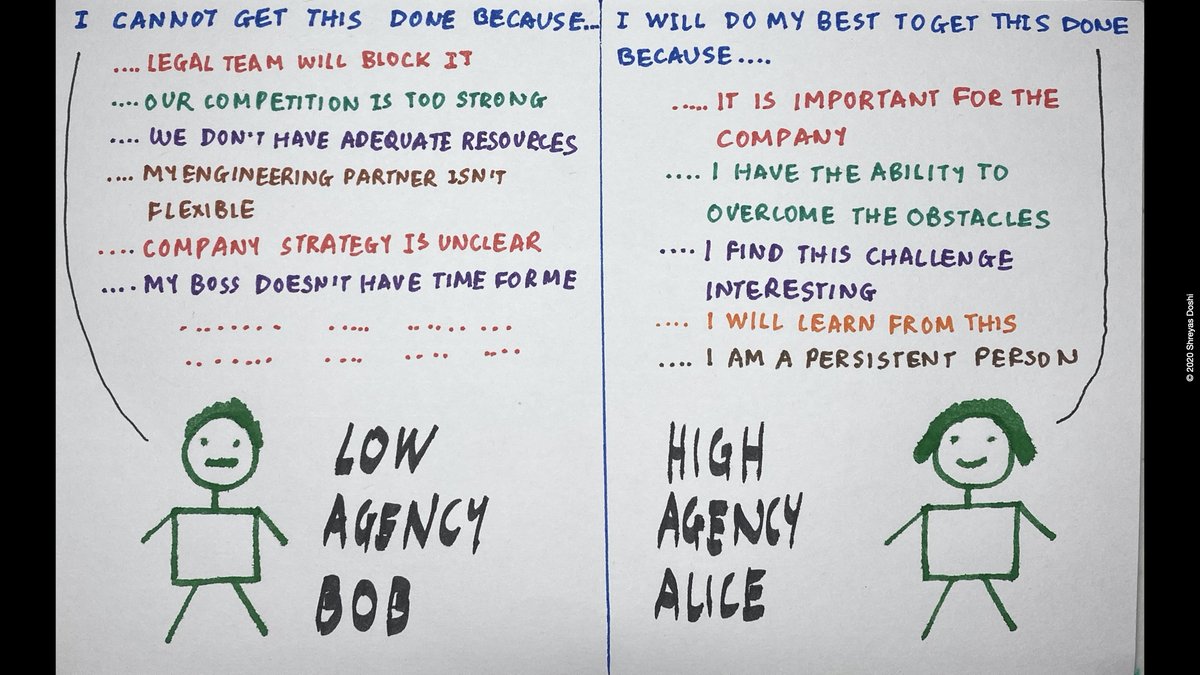
Shreyas Doshi’s thread illustrates the same gap with two stick figures: low-agency Bob, whose reasons are external (the legal team, the competition, the resources, the boss); and high-agency Alice, whose reasons are internal (importance, ability, interest, learning, persistence). The diagnostic is the sentence stem: I cannot, because… versus I will, because….[2]
The combined effect is a kind of pre-emptive shrinking. The low-agency person decides, before doing anything, that most of the moves available to them are not actually available. They are the bouncer at their own life.
Why it matters now
This trait has always mattered. There is a specific reason to pay attention to it in 2026.
Cate Hall: “The idea that intelligence is not what matters — because intelligence is becoming cheap — is growing.”[5] That observation is doing a lot of work. Until very recently, execution was scarce. If you could ship a working product, prove a piece of code, or write a competent draft, you had a meaningful edge over the average person who could only describe what they wanted. That edge is collapsing. Anyone with a good prompt can ship a working product now. Anyone who can describe a draft can have a draft. The cost of execution is approaching zero across an enormous range of work.
What does not collapse is judgement about what to make, who to call, and which constraint to ignore. The bottleneck has moved upstream — from the hands to the head, from the doing to the deciding. Sahil Bloom puts it bluntly: “we’re entering a historically good period for those with hunger, high-agency, and bias for action.”[19]
The mainstream management literature has caught up. Nir Eyal, writing in Harvard Business Review in March 2026: “In an era when AI, geopolitical instability, and constant reorganization make it tempting to conclude that nothing you do will change what happens next... agency is not a personality trait. It is a learnable capability.”[20]
This is good news for individuals and inconvenient news for institutions. The institutions that have done well over the past decade have done so partly by aggregating execution at scale. Their advantage shrinks as execution becomes cheap. Smaller, more agentic actors — single people, two-person teams, small companies — get a structural tailwind they have not had since the early internet.
How to develop it
Main article: How to Build High Agency (and Why Most People Don’t)
Almost everyone serious about this question agrees that high agency is at least partly developable. Shreyas Doshi: “Some ppl are born/raised with High Agency. It can also be developed later in life.”[2] Cate Hall: “Agency is something that can be deliberately cultivated by a lot more people.”[5] Eyal in HBR: “It is a learnable capability.”[20] There is no consensus on a single recipe, but several mechanisms recur.
Build, don’t only consume. Patrick Collison, in his advice page: “Make things. Operating in a space with a lot of uncertainty is a very different experience to learning something.”[14] Most of agency comes online during construction, not during reading.
Choose your environment. Cate Hall: “You can osmose agency from your environment if you’re exposed to the right kinds of people.”[5] Patrick Collison: “Make friends over the internet with people who are great at things you’re interested in.”[14] The single biggest leverage point most people have is who they spend time with.
Tighten the feedback loop. Stripe’s “speed of fruitful iteration”;[13] Drew Houston posting his demo to Hacker News and reading the comments.[12] The agentic move is not just to ship — it is to find out whether what you shipped worked, fast.
Notice degrees of freedom. Hall’s definition is partly diagnostic: agency is “the capacity to both see and act on all of the degrees of freedom that life offers.”[5] Most of the move is the seeing. Build a habit, every day, of noticing one constraint you have been treating as fixed and asking whether it actually is. It often is not.
Reframe the timeline. A pointed prompt George Mack attributes to Peter Thiel: “How can you achieve your 10 year goal in 6 months?”[22] The question is useful even when the answer is “you can’t,” because the work of trying to answer it forces you to identify which steps in the standard ten-year plan are real and which are convention.
Stop waiting for permission. Stepfanie Tyler: “We don’t wait for permission that’s never coming.”[18] This is the part that sounds aggressive and isn’t, quite. Most of the time the permission is not coming because nobody has the authority to grant it; the structure is convention, not command.
Mack closes his thread with three lines worth keeping in mind: question everything, bend reality, never outsource your decision making.[22] Each of these collapses to a small daily habit; the compounding effect over years is a person who is no longer recognisably the same.
You will be wrong sometimes. You will push on a door that turns out to be a load-bearing wall, and you will look foolish or rude. This is unavoidable and not very expensive. Treat agency as a probability bet running across thousands of small decisions, and the math works out.
Critiques
The discourse around high agency is not unanimous, and a clear-eyed article should record the strongest objections.
It may be a buzzword for older constructs. The social psychologist Katharine Greenaway, summarised by Jessica Stillman, points out that high agency is “an umbrella term for a range of traits that psychologists have studied for decades”— including self-efficacy, locus of control, conscientiousness, autonomy, and competence. Calling all of them “high agency” can obscure rather than clarify.[21]
It depends on observer bias. Greenaway again: “Actions that see one person praised as a ‘game changer’ could easily see another labeled a ‘troublemaker’.”[21] The same behavior can read as agentic or as out-of-line depending on who is doing it. The label is partly status-conferral.
It can privilege the already-privileged. Greenaway: “An obsession with ‘high agency’ individuals could end up privileging the already privileged and setting up additional pitfalls for those who already face barriers.”[21] Advice to “just do things” underweights class, capital access, and downside risk. A teenager in San Francisco emailing a famous founder and a teenager doing the same thing in a country where the wrong email gets you flagged are not running the same experiment.
It can become founder mythology. Hall: “LARPing as a high-agency person by following the playbook of a tech founder seems unlikely to be a true exercise of agency.”[5] Mistaking the rituals for the disposition is a common enough failure mode that it is worth naming.
It is not automatically moral. This is the most serious critique. Hall: “Agency itself is not necessarily a good thing. It becomes a good thing as a toolkit, developed by people who are also high in conscientiousness, who want good things for the world.”[5] Agency without conscientiousness produces highly effective harm.
The right response to all of these is not to discard the concept but to use it carefully. High agency is a real and useful disposition. It is also a label that gets handed out unevenly, attaches itself to a particular kind of mythology, and amplifies whatever it is paired with. Both things are true.
The world is more malleable than it appears. The only way to discover how malleable, for the specific person you are in the specific situation you are in, is to push on it.
See also
- 20 Examples of High Agency in the Wild — a wider catalogue of cases beyond the seven discussed above.
- Low Agency: The Opposite of High Agency — a fuller treatment of the symptom patterns and academic antecedents.
- How to Build High Agency (and Why Most People Don’t) — practical drills, drawn from primary sources.
- The Best Quotes on High Agency — a curated quote bank with full attribution.
- What to Read to Develop High Agency — books, essays, and academic papers.
References
- Eric Weinstein, Interview transcript, The Tim Ferriss Show #131, 13 January 2016.
- Shreyas Doshi, X thread on agency vs. talent, 27 June 2020.
- Naval Ravikant, On hiring high-agency people, 2024.
- George Mack, High Agency in 30 Minutes, 2024.
- Cate Hall, “Can You Just Do Things?”, Asterisk Magazine, 2026.
- Paul Graham, “Relentlessly Resourceful”, March 2009.
- Albert Bandura, “Self-efficacy: Toward a Unifying Theory of Behavioral Change”, 1977.
- Julian B. Rotter, “Generalized expectancies for internal versus external control of reinforcement”, 1966.
- Martin E. P. Seligman, “Learned Helplessness”, 1973.
- Rory Cellan-Jones, How Demis Hassabis met Peter Thiel.
- NASA / Ed Smylie, Apollo 13 oral history (CO₂ filter improvisation), 1999 interview.
- Drew Houston, On starting and scaling Dropbox (YC Startup Library).
- Patrick Collison, Running Your Startup transcript.
- Patrick Collison, Advice.
- Fortune, Brian Chesky on the Obama O’s and Cap’n McCain’s cereal sales, April 2023.
- Yahoo Finance, Melanie Perkins on ~100 VC rejections.
- Palmer Luckey, Oculus Rift HMD prototype thread, MTBS3D forum.
- Stepfanie Tyler, “High Agency People Are Annoying”, Bad Girl Media, October 2025.
- Sahil Bloom, Reflections from a think-week retreat, May 2025.
- Nir Eyal, “How Leaders Can Build a High-Agency Culture”, Harvard Business Review, March 2026.
- Jessica Stillman, summarising Katharine Greenaway, “High agency is a hot business buzzword”, Actually Human (reprint), April 2026.
- George Mack, Thread on high agency thinking (X), 30 November 2018.