Low Agency: The Opposite of High Agency
Low agency is the disposition to be acted on by the world rather than to act on it. It is closer to what Paul Graham calls hapless — being “battered by circumstances, to let the world have its way with you”[1] — and what Martin Seligman called learned helplessness[4] than to laziness. George Mack puts it bluntly: “low agency is the default setting for most of us.”[2]
That is the short answer. The rest of this article is about how the disposition is recognised in primary sources, where it comes from in the academic literature, what it looks like day-to-day, why it persists culturally, and what to do about it.
Definitions
Most modern definitions arrive at the disposition by inverting high agency. Paul Graham’s 2009 essay Relentlessly Resourceful gives the most useful one-line picture: “hapless implies passivity. To be hapless is to be battered by circumstances”[1] — the world acts; the person reacts.
George Mack’s widely-shared site High Agency in 30 Minutes frames the same point from above: “low agency is the default setting for most of us.”[2] Cate Hall, in a 2026 Asterisk magazine interview, locates the failure mode precisely. Her former pattern and that of the people she meets — “okay, somebody just tell me what to do so I can be good” — produces, by her own description, susceptibility to groupthink.[3]
The pattern is consistent across these sources. Low agency is not an absence of effort, intelligence, or moral seriousness. Many low-agency people work hard. It is a settled belief that the path is fixed — that the form is the form, that gatekeepers are gates rather than people, and that “no” ends a conversation rather than starting one.
Academic antecedents
The modern startup-world usage of “low agency” sits on top of three distinct strands of research, each describing a different facet of the same disposition.
Learned helplessness (Seligman, 1973)
Martin Seligman’s 1973 paper is the dominant academic reference for what low agency feels like from the inside. In a series of experiments with dogs, animals subjected to inescapable shock continued to behave as if escape were impossible after the conditions changed and escape was, in fact, available. Seligman characterised the result as “passivity in the face of trauma, inability to learn that responding is effective”[4]. The construct is now standard in clinical and social psychology. Hall describes the human analogue: people who treat their current constraints as immutable because, somewhere upstream, they learned that constraints were.[3]
External locus of control (Rotter, 1966)
Julian Rotter’s 1966 paper introduced a related construct: a person’s locus of control is internal if they believe outcomes depend on their own behavior, and external if they believe outcomes depend on luck, fate, or, in his words, “powerful others.”[5] External locus is closely correlated with low agency, though the two are not identical. Locus of control is an expectancy about how the world works; agency is a disposition to act on the world. They reliably co-occur.
Self-efficacy (Bandura, 1977)
Albert Bandura’s 1977 paper introduced self-efficacy as the cognitive precondition for action: “expectations of personal efficacy determine whether coping behavior will be initiated, how much effort will be expended, and how long it will be sustained.”[6] Low self-efficacy is the inner mechanism behind low-agency behavior. People who do not expect their actions to matter rarely take them.
The three constructs — learned helplessness, external locus of control, and low self-efficacy — describe the same internal architecture from three different angles. The modern tech-world phrase “low agency” is loosely the union of all three.
Symptoms in practice
Four characteristic patterns recur in writing on the disposition.
Treating defaults as immutable. The default career path, the default tool, the default schedule, the default response to a request. The agentic move is to ask, what if this were different? The low-agency move is to not notice it could be. This is the most common form because it is invisible to the person in it — there is no decision to push back against, only a choice that was never recognised as a choice.
Deferring to procedure when procedure is not binding. There are situations where the rules are the rules — air traffic control, FDA approvals, criminal law. There are situations where the rules are a suggestion the system has settled into — most internal corporate processes, dress codes, “you have to apply through the careers page.” Distinguishing the two is most of the skill. Low agency collapses both into the first category.
Reading “no” as a final answer. Eric Weinstein’s framing on The Tim Ferriss Show describes the high-agency response: when told something is impossible, “is that the end of the conversation, or does that start a second dialogue in your mind?”[7] The low-agency response is that it ends the conversation. In most situations — outside of formal institutions — no is a starting offer.
Reading the syllabus as the curriculum. School trains people to do exactly what is asked, on the schedule given, at the level of completeness specified. Low agency in adulthood is the unedited continuation of that habit. Most of life is not graded on a rubric.
The Bob/Alice diagnostic
A useful diagnostic shorthand comes from Shreyas Doshi’s 2020 X thread.[8] Doshi sketches two stick figures. “Low Agency Bob” lists external reasons a task cannot be done — the legal team will block it, the competition is too strong, resources are inadequate, the boss doesn’t have time. “High Agency Alice’s” reasons are internal — it matters, she can learn, she is persistent.
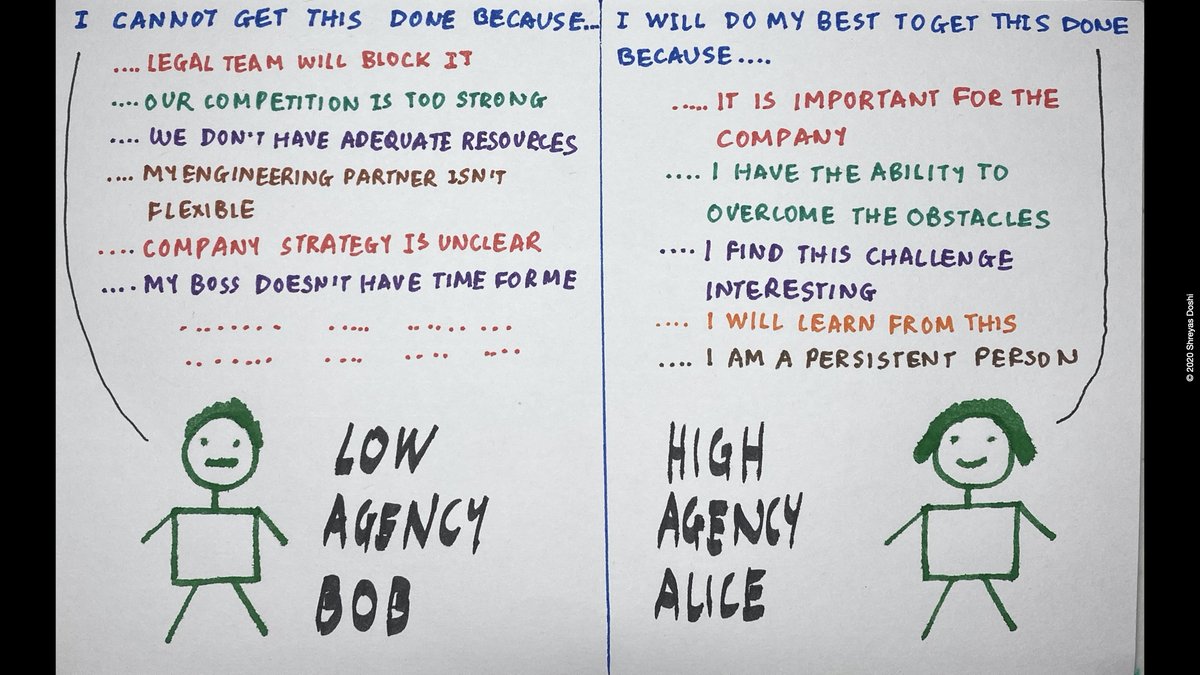
The diagnostic is the sentence stem: do you complete I cannot, because… with external constraints, or I will, because… with internal commitments? The ratio across a typical week is the closest thing to a self-administered low-agency test.
Cultural conditions that produce it
Two recent books frame structural reasons low agency may be unusually common in the present.
Tyler Cowen, The Complacent Class (2017). Cowen argues that Americans have moved away from restlessness toward sorting and stability, summarising the shift as: “Americans today have broken from this tradition — we’re working harder than ever to avoid change.”[9] The aggregate effects, in his account, are reduced economic dynamism, lower geographic mobility, and a cultural premium on staying in lane. None of these are individual failures; they are collective signals.
Jonathan Haidt, The Anxious Generation (2024). Haidt’s argument is about childhood: continual adult supervision and the loss of free play, he writes, “deprived children of what they needed most… the chance to explore, test and expand their limits.”[10] Children who never test boundaries grow into adults whose sense of what is testable is narrower.
Hall describes the resulting psychology directly. Her former pattern — “okay, somebody just tell me what to do so I can be good”[3] — is, in her account, a coping strategy that produces measurable predictability in environments that punish the alternatives. Low agency, on this reading, is partly rational. It is the equilibrium response to a long sequence of punished initiative.
What low agency is not
Several common interpretations fail when examined.
It is not laziness. Many low-agency people work hard. The hours are not the question. The question is which hours, on which problems, by whose direction.
It is not depression. There is overlap — depression and learned helplessness share neurochemical features, which is part of why Seligman’s work travelled into clinical psychology — but low agency is a stable disposition, not a clinical state. Many low-agency people are otherwise psychologically well.
It is not prudence. Risk aversion can look like low agency from outside, but the agentic person and the prudent person both run a careful calculation; the agentic person more often discovers that the risk is smaller than the institutional default suggests.
It is not deference to genuine authority. A pilot who follows tower instructions is not low-agency. The line is drawn at binding — agency means recognising which structures are real.
Moving toward agency
Main article: How to Build High Agency (and Why Most People Don’t)
A full guide to developing the inverse disposition lives at /how-to-build. The condensed version, drawn from primary sources:
- Notice one constraint each day you have been treating as fixed and ask whether it actually is.
- Choose the environment you spend time in. Hall: “you can osmose agency from your environment if you’re exposed to the right kinds of people.”[3]
- Build, don’t only consume. Patrick Collison: “make things. Operating in a space with a lot of uncertainty is a very different experience to learning something.”[11]
- Pay attention to your sentence stems. I cannot, because… versus I will, because….
Critiques
Two arguments worth recording.
The first, from the social psychologist Katharine Greenaway (summarised by Jessica Stillman), is that a focus on individual low agency tends to underweight environment. Her line: “an obsession with ‘high agency’ individuals could end up privileging the already privileged.”[12] The same behavior reads as agentic when one person does it and as troublemaking when another does. Some low-agency-looking patterns are rational responses to environments that do, in fact, punish action.
The second, from Cate Hall, is to avoid moral hierarchy: “the idea that some people do not count because they are not thinking for themselves in the way that the speaker believes they should is, to me, really vile.”[3] Low agency is a description of a disposition. It is not a verdict on the person who has it.
The cleanest position is probably this: low agency is real, has identifiable cognitive antecedents, can be recognised by symptoms, and can be partially developed away from. It is not a moral failing, it is not always the individual’s fault, and the path away from it depends as much on environment as on will.
See also
- What is High Agency? — the canonical definition essay.
- 20 Examples of High Agency in the Wild — the inverse pattern in action.
- How to Build High Agency (and Why Most People Don’t) — practical drills.
- The Best Quotes on High Agency
- What to Read to Develop High Agency
References
- Paul Graham, “Relentlessly Resourceful”, March 2009.
- George Mack, High Agency in 30 Minutes, 2024.
- Cate Hall, “Can You Just Do Things?”, Asterisk Magazine, 2026.
- Martin E. P. Seligman, “Learned Helplessness”, 1973.
- Julian B. Rotter, “Generalized expectancies for internal versus external control of reinforcement”, 1966.
- Albert Bandura, “Self-efficacy: Toward a Unifying Theory of Behavioral Change”, 1977.
- Eric Weinstein, Interview transcript, The Tim Ferriss Show #131, 13 January 2016.
- Shreyas Doshi, X thread on agency vs. talent, 27 June 2020.
- Tyler Cowen, The Complacent Class (Mercatus / St. Martin’s), 2017.
- Jonathan Haidt, The Anxious Generation (official book page), 2024.
- Patrick Collison, Advice.
- Jessica Stillman, summarising Katharine Greenaway, “High agency is a hot business buzzword”, Actually Human, April 2026.